A MANGER, AN OPEN FIELD, A STAR
[6-minute read]
People generally have a pretty standard assumption that messy situations always lead to bad outcomes. But consider the childbirth experience – lengthy involuntary contractions, the intense pain and the amount of blood in the picture. What appears chaotic produces the much-anticipated birth of a child. Or picture surgery of any kind: the living body is not made of neat compartments but overlapping parts constantly reacting to what is being done on any part. The operating theatre is not a place of beauty and order but where precision, time and patient safety are prioritized over appearances. Finally, step into a busy restaurant kitchen: nothing resembles the beautifully plated dishes that is capable of producing.
So, is every mess a problem, or can some lead to unexpected good?
We all know that the events leading up to the birth of the infant Jesus were unusual and unexpected. The premarital conception, giving birth in a stable, putting the newborn in a feeding trough. Mary and Joseph were navigating uncharted territories and did not have the benefit of prior experiences or historical references to draw from. So, one might even question if God Himself knew what He was doing!
In all, Christmas started with a miraculous conception that defied the ordinary story of human beginnings. God, who used the sound of ram’s horns and human voices to bring down the stone and brick walls of Jericho once again used ordinary and familiar settings as the backdrop for His Son’s birth.
We’ll look at three symbols of Christmas to examine their hidden meaning.
A MANGER
In biblical times, a manger was a feeding trough for livestock and not a crib you would typically place a newborn in. Also, stables had more sheep lambing, horse foaling, cows calving than humans giving birth. It did not even have the basic hygiene and safety to support a new mother and her infant.
The scene was captured by Max Lucado who wrote, “Majesty in the midst of the mundane. Holiness in the filth of sheep manure and sweat. Divinity entering the world on the floor of a stable, through the womb of a teenager and in the presence of a carpenter. She touches the face of the infant-God.”
The Bible recounted, “She gave birth to her firstborn son (without midwives). She wrapped him snugly in strips of cloth and laid him in a manger (not a crib), because there was no (human) lodging available for them.” (Luke 2:7 NLT, paraphrased).
Today, we find the nativity scene so enchanting when back in the day, it was actually quite controversial! For a start, Mary and Joseph were engaged – not even married – yet they were expecting a baby. And they took a big risk to travel when Mary was in advanced stage of pregnancy.
Things could not have been less ideal.
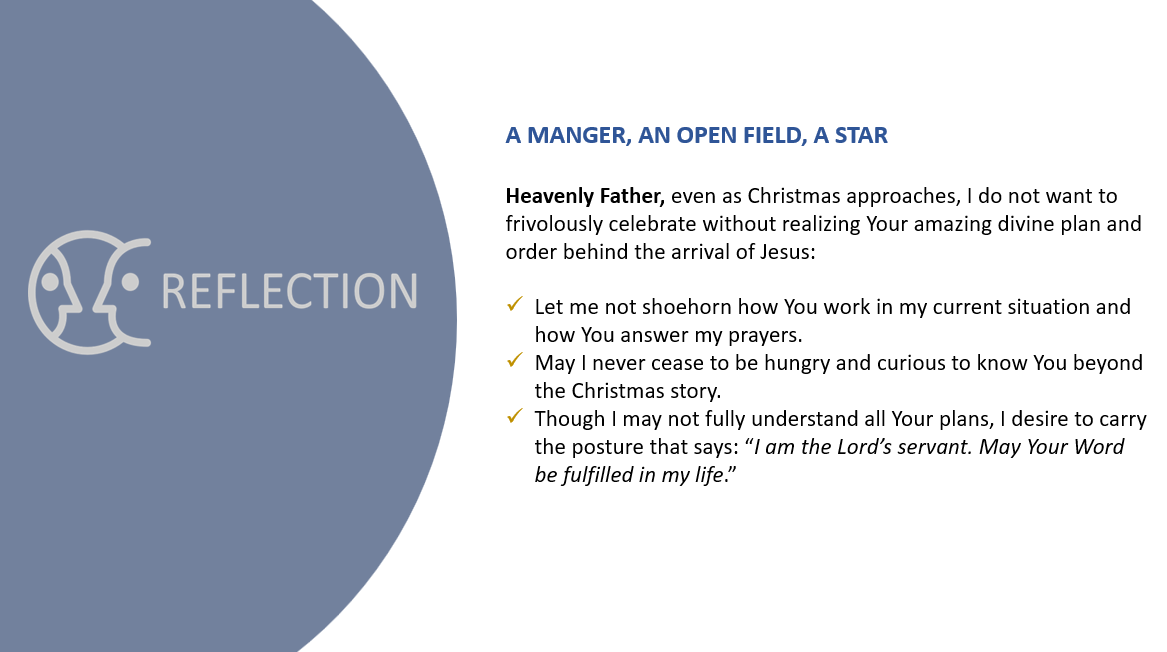
But the key point here is that we should not shoehorn God’s plans into our own mental ideals of what good looks like. Today, the choice of crib for the One who called Himself ‘the Bread of Life’ (John 6:35) no longer looks odd. Besides, shepherds were more familiar with a manger than the manager of an inn.
OPEN FIELD
Shepherds in biblical days often lived nomadically in rough conditions. To find them you’d need only to locate their flocks. They were low-level workers and marginalized members of society – the last to know anything because they spent long hours outdoors tending flocks instead of moving freely in their communities or plugged into the social grapevine.
But God reserved for them the most important news for humanity. “The angel said to them, ‘Do not be afraid. I bring you good news that will cause great joy for all the people. Today in the town of David, a Saviour has been born to you; He is the Messiah, the Lord. This will be a sign to you: you will find a baby wrapped in cloths and lying in a manger.” (Luke 2:8-12).
Really, who could be better at finding stables and mangers than shepherds? While they might not have the right dressing to enter inns, or the refined speech to engage wealthier inn-keepers, they could quietly slip into any stable to search for a baby in a manger without being turned away.
What’s more, the shepherds were the only audience to witness heaven’s open ‘live’ theatre: “Suddenly a great company of the heavenly host appeared with the angel, praising God and saying, “Glory to God in the highest heaven, and on earth peace to those on whom his favor rests.” (Luke 8:13-14).
Least the shepherds thought that such good news should be confirmed and announced by more qualified or educated people, this theophany was powerful enough to erase all their doubts.
“When the angels had left them and gone into heaven, the shepherds said to one another, “Let’s go to Bethlehem and see this thing that has happened, which the Lord has told us about.” So they hurried off and found Mary and Joseph, and the baby, who was lying in the manger.” (Luke 8:15-16).
STAR
No one knows more about stars than astrologers with a deep knowledge of galaxies. While we do not know if the three wise men were astrophysicists or not, there was no doubt that they were stellar experts - men who had spent time studying the galaxies and discerned the birth of Jesus in their star gazing.
“About that time that Jesus was born, some wise men from eastern lands arrived in Jerusalem, asking, “Where is the newborn king of the Jews? We saw His star as it rose, and we have come to worship Him.” (Matthew 2:2).
They followed one particular star - now called the Star of Bethlehem - that was prophesied pre-Christ in Numbers 24:17, “I see Him, but not now; I behold Him, but not near. A star will come out of Jacob; a scepter will rise out of Israel.”
When God reveals something that doesn’t seem to make sense, what is your response?
When an angel revealed to Zechariah that he would have a son in old age. He asked the angel, ‘How can I be sure of this? I am an old man and my wife is well on in years.’ (Luke 1:18).
Not long after, when another angel revealed to Mary how her virgin conception would happen, she responded, “I am the Lord’s servant. May Your Word be fulfilled in my life.” (Luke 1:38). “But she had also asked, ‘How will this be since I am a virgin?”
Looking at both their response, it is easy for us to conclude that one asked the ‘right question’ and the other didn’t. Both had their miracles! Make no mistake: God is very clear about the challenges we are up against. Zechariah and his wife were well beyond childbearing age, and virgins do not get pregnant on their own. Yet, God’s miracles would happen in spite of all that.
What have you been praying these past several months and the breakthrough you hope to see in your life or in a loved one? Open your eyes and mind to see that His vision and thoughts are not like yours. Are you stuck in some ways and you know that nothing could change if it depended on you alone?
Remember, God’s thinking, wisdom and knowledge are superior than ours. It is futile to outthink God. Just take His Word for it and trust Him for your personal miracles. (Read Isaiah 55:8-9 and Romans 11:33-35 NLT).
This is a summary and reflection based on a virtual BIR Session held on 13 November 2025.