DEEP REFLECTION DRAWS DEEP CONNECTION
[9-minute read]
ARE YOU AFRAID TO GO DEEP? In conversations, do you stick to safe topics to avoid bringing up personal opinions and feelings. Do you prefer surface-level interactions, sharing general updates without saying much about yourself. Are you constantly busy and occupied, yet lack relationships with real depth?
Important relationships need the nourishment of attention and open conversations. The superficiality and ambivalence of our interpersonal connections often carry over into the way we connect with God. We quote Scripture back to God instead of telling Him how we really feel. We read Scripture without pausing to let it speak to us. Instead of evolving with the Word of God, we are concerned only with religious programmes and activities. We beat ourselves up for feeling hurt, anguish and disappointment instead of bringing our emotional and mental struggles to the One who knows us more intimately than we even know ourselves.
When we learn to engage in deeper reflections of God, we will enjoy a deeper connection with Him.
Ten days into the new year, we must rebuild and guard our personal altars. This is not about external displays of pictures, plaques and burning candles, but inward places of devotion. Altars mark moments of encounter with God that changes not only our personal destiny, but also our communities. In the Old Testament days, people acknowledge the presence of God with altars. Jacob wrestled with the angel of God and called the place Peniel, meaning “the face of God.” (Genesis 32:22-30). Isaac set up an altar to God who assured him of his calling (Genesis 26:24). Moses built an altar called ‘The Lord is my Banner’ as a monument of military victory (Exodus 17:15-16). And David built an altar to God to symbolize sacrificial obedience (2 Samuel 24:24–25).
Keep a prayer journal and note the altars of engagement with God in your regular time with Him. Illustrate it with an inspired drawing. Write down the song that comes to you. Our relationship with God is one that can be documented so we do not forget the lessons learnt, the confessions made, the rebuke we receive from God and the revelations that set us free from being stuck!
#1 ALTAR OF CONFESSION
Some people think that confession is about being apologetic about negative emotions when feelings are our God-given emotional language. This is where most of us get stuck. Regret tells us something or someone valuable to us that we have neglected and are at risk of losing. Anger indicates a lack of agreement and alignment with others. Disappointment exposes the withholding of honesty in order to please others. Confession involves asking God to help us understand our emotions in relation to others instead of suppressing them.
What does this vulnerability and transparency with God sound like? The Psalmist offers an excellent example: “Search me, God, and know my heart; test me and know my anxious thoughts. See if there is any offensive way in me, and lead me in the way everlasting.” (Psalm 139:23-24). Even if it feels uneasy, the discomfort we feel is short-term compared to the long-term gain in the right type of confession with God. This is because the result of confession is freedom from distress and a release from entrenched sins that lurk in our subconscious and unconscious mind.
“Then I acknowledged my sin to You and did not cover up my iniquity.” (Psalm 32:5).
Standing in God’s penetrating light that exposes everything can feel unnatural and even unsafe, but we can be sure that we have the filter of His grace so that His Truth brings not shame but only healing and the restoration of our confidence in Him. This is the assurance we have from God, that “If we confess our sins, He is faithful and just and will forgive us our sins and purify us from all unrighteousness.” (1 John 1:9).
#2 ALTAR OF PRAYER
The Bible repeatedly makes it clear that prayer is a powerful antidote to anxiety and weakens its grip over us. People who habitually pray do not fight for control because they know who is in control. They know they don’t own the narrative over what is happening in their lives; but they ask God what they are to do in His narrative.
Whether it concerns an illness, a relationship, a business project or anything in life, Scripture tells us to respond in prayer, not in control of the narrative no matter how convincing it sounds. “Do not be anxious about anything, but in every situation, by prayer and petition, with thanksgiving, present your requests to God.” (Philippians 4:6-7).
In your prayer, ask God to help you see what you are not seeing. Allow God to show you His perspective and keep asking till all the internal barriers and defenses in you submit to His revelation. This will take more time for those of us who defaults to logic and what appears right for our actions.
Doing nothing is the easiest option that takes very little effort. When we pray in faith, we must act with faith. But what if we are unsure if our plan of action is the right course. Well, God will always have His way for course correction!
If you feel called to write, start reading and taking note of good writing to hone your skills.
If you feel called to join the worship team, be committed to show up for rehearsals.
If you feel called to find work in a new field, start looking at job boards to see your employability and what you need to do to upskill to improve your hireability.
James 1:5-8 [NASB] addresses this point: “But if any of you lacks wisdom, let him ask of God, who gives to all generously and without reproach, and it will be given to him. But he must ask in faith without any doubting, for the one who doubts is like the surf of the sea, driven and tossed by the wind. For that person ought not to expect that he will receive anything from the Lord, being a double-minded man, unstable in all his ways.”
Have you ever been asked by someone for an advice or an opinion and after you have given it, the person says, “I’m not sure about that.” That’s what it’s like when we second-guess anything that we don’t like to hear from God. Are you sure, God?
We pray that in 2026, your altar of prayer will be a place of greater personal transformation.
#3 ALTAR OF GOD’S WORD
Reading the Word of God is not like chanting. There is literally no way that we will not evolve if we truly read the word of God, meditate on it with our heart and spirit, and let his Living Word teach, correct and instruct us. We cannot be students of the Word and not become more Christlike in our ways.
When people say we have not changed, we should ask them what they mean. It is not always a compliment to a disciple of Jesus Christ to have not evolved. If there is no observable evidence of change in us as a result of habitual study of God’s Word, it shows we have not responded to it. Period.
The living Word of God has the power to release us from inertia, excuses and pretenses. It renews and replaces our thinking with God’s way of thinking. “We demolish arguments and every pretension that sets itself up against the knowledge of God, and we take captive every thought to make it obedient to Christ.” (2 Corinthians 10:5).
God’s Word has great life transforming power so that Christians are instructed to reflect deeply on it. The verses below show that when we meditate on God’s Word, our response is action even when there is no guarantee of success. We act by faith anyway. You may displease some people. You may look dumb (only to yourself). But what you do will have the right Kingdom impact.
“Keep this Book of the Law always on your lips; meditate on it day and night, so that you may be careful to do everything written in it. Then you will be prosperous and successful.” (Joshua 1:8).
“Blessed is the one …whose delight is in the law of the Lord, and who meditates on his law day and night.
That person is like a tree planted by streams of water, which yields its fruit in season and whose leaf does not wither – whatever they do prospers.” (Psalm 1:1-3).
#4 ALTAR OF WORSHIP
Worship is not merely an outward or emotional response to uplifting and inspiring music. It is an internal response to God. Apart from God, there is no worship in the same way that we can’t say we have a relationship with someone we never spend time with. Or say we value our marriage if we don’t habitually show kindness to our spouse.
Think of the time you are with someone who is constantly checking their phone when you are together. It is just as rude and irreverent to be constantly running checks on other things in our minds when we are in the presence of God. He responds to our sincerity and not to our scheduled time with Him.
Indeed, Romans 12:1 (NLT) tells us that worship is a full body experience - taking up both physical space and time in our lives. We do not have a secret affair with God that we should be talking about squeezing Him into stolen moments of 5 or 10 minutes, whenever our busyness allows. Worship postulates a willingness to surrender to God, even as we sing the song ‘Yet Not I But Through Christ In Me.’
Worship triggers thanksgiving when we acknowledge how deeply God is involved in the details of our lives and in the unfolding of our lived realities. In the movies, we see God showing up when no one is around; but in reality, He is present even in a crowded place. Or when someone delivers an unfavourable piece of news to us, in the boardroom when we ask Him ‘what is important to You?’, in a conflict when we feel attacked, or in a waiting room outside the doctor’s office dreading the medical report.
We thank Him for His presence in those moments when we feel the loneliest and most powerless. This certainty is not a given; it is a conviction in the absence of evidence. It is not faking it till you feel it. It is believing that God is good and God is with us even when we don’t feel it because the Word of God says He is with us.
Worship is not a mind game. It is exuberant (Hebrews 13:15, Psalm 95:1-2). Our connection with God deepens when we recognize His voice and discern when He speaks to us.
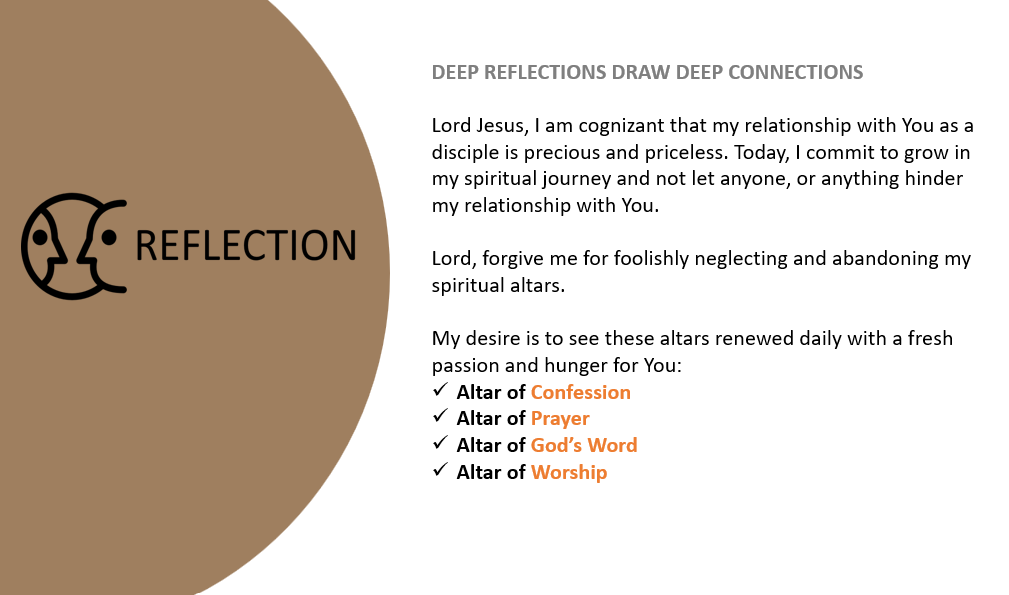
Don’t let disappointments in life put a pause on the rebuilding of the four spiritual altars of confession, prayer, God’s Word and worship. God shows up and responds to us at these altars.
Make your altars real. Start a journal of your experience and His revelations.
This is a summary and reflection based on a virtual BIR Session held on 10 January 2026.