MARKS OF SPIRITUAL MATURITY
[5-minute read]
It is unfortunate that Christianity is widely perceived as a rules-based religion that prioritizes group conformity over a genuine relationship with God. It doesn’t help that many believers also lack the ability to discern the difference when they face conflicting loyalties, and choose to keep up a unified front instead of doing what is right with God.
This happens when loyalty to institutional traditions and practices is elevated above spiritual growth. What then are the true marks of spiritual maturity?
Here are 3 strong indicators:
#1 YOU WILL KNOW HOW TO BE STILL
Knowing how to be still means resisting the urge to over-perform in order to please or outperform others, to control the narrative, or to manipulate outcomes in seasons of uncertainty. In other words, it means to refrain from competing with God for control.
There is indeed no better time to trust God than when something at stake means everything to us.
When we are anxious about the end-of-life care for a loved one. When we are in the threshold of making a major life decision. When nothing in the natural assures us of a good outcome. To be still means to resist every internal impulse to react to the situational demand, to act on the fight or flight instincts, and to refrain from struggling and striving because that will only perpetuate existing anxieties.
Back in the day when the entire Israelite exodus were fleeing Pharoah and his elite army, Moses had no other strategy than telling the helpless people, “The Lord will fight for you; you need only to be still.” (Exodus 14:14). That was his best and only war strategy!
In Psalm 46:9-10, the God who ‘makes wars cease to the ends of the earth’ had said, ‘Be still, and know that I am God; I will be exalted among the nations, I will be exalted in the earth.’ God was not joking. God had a long track record to back up His Word.
Being still potentially transforms us as the independent variable in any situation that God will manipulate to change outcomes. But being still does not mean to freeze and numb ourselves emotionally. Often there are risks involved in withholding action. However, risks do not exist in a vacuum; God is able to alter realities to mitigate the risks.
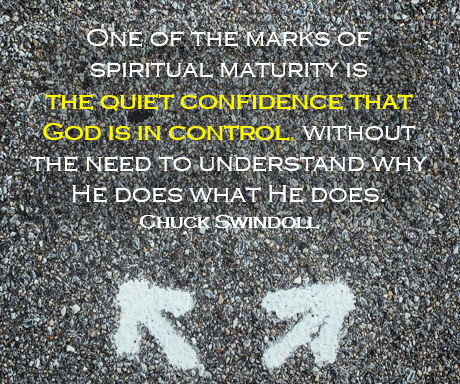
#2 GUARD YOUR HEART, MOUTH, EYES & FEET
Sometimes, we spend far too much time adjusting what we say to suit our audience, or we avoid saying anything so we will not be negatively perceived. Appearances and perceptions matter and we are careful to curate the ‘right impression’ that reflects godliness.
If only we switch our focus to aligning our response and reading of situations with God instead, it would sustain not only our physical health, but also the quality of our lives. For this reason, God said, “My son, pay attention to what I say; turn your ear to my words. Do not let them out of your sight, keep them within your heart; for they are life to those who find them and health to one’s whole body.” (Proverbs 4:20-22).
To grow up, we need to discard any spiritual pacifiers, and disassociate from any spiritual nannies. These are the people we spend a lot of time with who reinforce immature behaviour and unhealthy status quo in our lives. They keep us stuck in spiritual infancy and cocooned in a “Christian bubble” where there are no hard-hitting questions, honest conversations, and Word-centred reflections that incubate change.
Hebrews 6:1 [NLT] warns us to “…stop going over the basic teachings about Christ again and again. Let us go on instead and become mature in our understanding. Surely we don’t need to start again with the fundamental importance of repenting from evil deeds and placing our faith in God.”
Who you spend time with will either inspire you to draw closer to God, or more dangerously, normalize a lukewarm relationship with Him.
#3 BE REAL & AUTHENTIC
More than we know, we can appear spiritually “together” while privately struggling. In trying to ‘save God’s face’ by putting our ‘best face’ forward, we withhold honesty and transparency with each other.
We cannot be interested only in spiritual renovations just to keep our heads above water so we don’t drown in our private sorrows and struggles. We cannot apply the Word of God only for superficial touchups and stop the Holy Spirit from carrying out deeper excavation and uprooting that precede real transformation.
The discipline of ‘critical thinking’ is often lost among believers because we downplay any experience that contradicts what we are taught and what we are told to believe in order to maintain corporate unity. In the process, we lose the vocabulary to even describe what we stand for and what we stand against. Silence deepens hurt and perpetuates unhealthy relationships when things that ought to be brought to light remain unspoken for the sake of preserving a sense of harmony.
The apostle Paul, on the other hand, was very transparent and open about himself: not only about his own failures, but also his beliefs, values and convictions. A great scholar and prolific preacher, he had a healthy dose of self-consciousness that enabled him to articulate his convictions, inner conflicts and what Christ did for him with authenticity.
Here’s what he famously said …
About his convictions: “And we know that God causes all things to work together for good to those who love God, to those who are called according to His purpose.” (Romans 8:28, NASB)
About Christ’s work in him: “Even though I was once a blasphemer and a persecutor and a violent man, I was shown mercy because I acted in ignorance and unbelief. The grace of our Lord was poured out on me abundantly, along with the faith and love that are in Christ Jesus. Here is a trustworthy saying that deserves full acceptance: Christ Jesus came into the world to save sinners – of whom I am the worst.” (1 Timothy 1:13-15).
About his inner conflicts: “I do not understand what I do. For what I want to do I do not do, but what I hate I do.” (Romans 7:15).
Examine your own life – your convictions, Christ’s work in you and your inner conflicts.Learn to articulate them.Pen them down as your goals for achieving spiritual maturity in 2026.
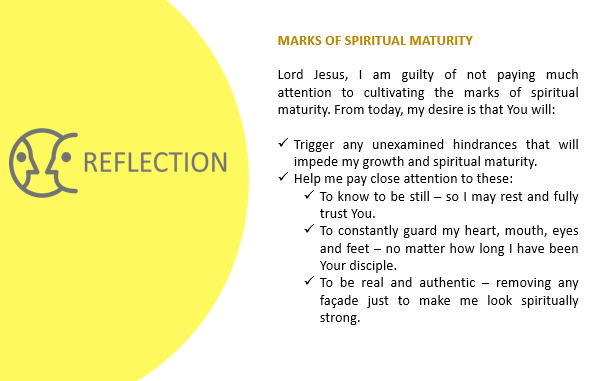
This is a summary and reflection based on a virtual BIR Session held on 31 January 2026.