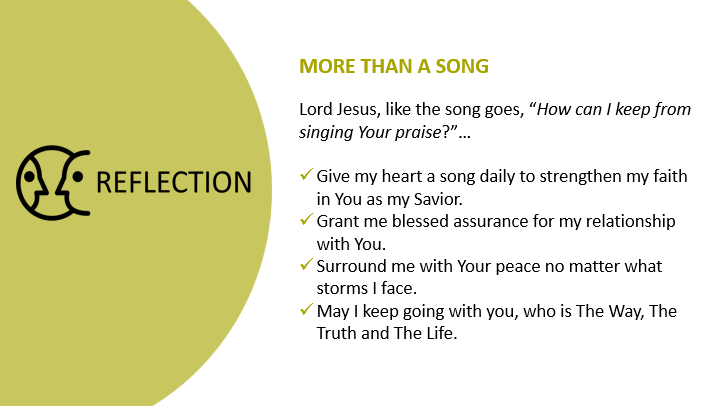
MORE THAN A SONG
[4-minute read]
ANYTHING WE DO OUT OF SELF-PRESERVATION will invariably involve minimizing personal pain and discomfort. On the other hand, there are people who will not let tragedy numb their emotions, pain to silence their voices, or disappointment to discolour their hope in Christ. These are people who know that they live for something larger than their own existence. They see their lives as threads handpicked by God Himself and weaved into the interconnectivity of life in the body of Christ, and they recognise the effect of personal choices on their shared destiny with others. They have a resilience that doesn't give them permission to give up easily even when they experience great distress because they know that their individual action can leave permanent marks in the fabric of their communities.
So, instead of drowning silently, they sing praise to God. Instead of letting emptiness fill their days, they find evidence of God’s grace. Instead of focusing on loss, they focus on God’s love. Instead of reacting to malice, they seek refuge in their relationship with God. They carry out their convictions of truly living for Christ.
Consider these three familiar songs that birthed out of personal tragedies yet inspired faith, assurance and hope to generations.
A SONG OF FAITH
I have decided to follow Jesus… If no one joins me, still I will follow, The cross before me, the world behind me…[the refrain] No turning back, no turning back.
You’d think that this hymn was written about a person who had it all - enjoying the full rewards of following Jesus. It’s as if the Cross is a neon light promising a crystal-clear view of the future leading us away from bleak realities.
The true story: this hymn was inspired by an Indian man called Nokseng who converted to Christianity through missionary work. To force him to renounce his faith, his children and wife were killed before his very own eyes. Yet, his final words were resolute, "I have decided to follow Jesus". After his death, this hymn inspired unwavering commitment to Christ in the face of intense persecution.
Nokseng lost his family and his own life but the village chief and the entire village gave their lives to Jesus.
What kind of stand and sacrifice do you make when criticized by your closest ones for demonstrating your faith?
A SONG OF ASSURANCE
Blessed Assurance …Jesus is mine….This is my story this is my song, Praising my Saviour all the day long…
The true story: this hymn, ‘Blessed Assurance’, is often chosen for funerals for its theme of confidence in the afterlife with Christ. It was penned by Fanny J. Crosby who, at barely six weeks old, was incorrectly treated for eye inflammation, resulting in total vision loss. Yet, she went on to become a prolific hymnist with more than 8,000 songs to her credit, and remained blind her entire life.
While Fanny was never able to give anyone physical directions or help the blind see, she did a great job of directing people to see Christ as their Saviour, and new possibilities with Him. When you are going through seasons of loss, facing setbacks and having your hopes shattered, how can your life continue to be a story of God’s assurance to others in real and practical ways (without the spiritual spiel)?
A SONG OF HOPE
“It Is Well, It Is Well With My Soul”.
The true story: this is another famous hymn that has delivered comfort to many in times of deep sorrow. It is not a song about denial but invokes a vision of God’s presence in quiet suffering. The lyrical words were personal to Horatio Spafford who lost all his 4 daughters when the SS Ville du Havre collided with another vessel and rapidly sank in 12 minutes in November 1873. His immediate response to the tragic loss was ‘It is well with my soul’.
The song’s theme of personal wellness against the backdrop of personal loss could not be more profound and perplexing if not for his hope in Christ. Indeed, it echoed the words of Jesus, ‘I have told you these things, so that in me you may have peace. In this world you will have trouble. But take heart! I have overcome the world.’ (John 16:33).
We may turn to songs for their self-soothing effects, or we can write lyrics with our life experiences to share with others. Good lyrics are not empty hyperbole; they touch on a range of human emotions and also invoke our heavenly response - shaping faith, grace, love and forgiveness as children of God.
Like the stories that inspired the three songs here, ultimately, our lives should rest on the truth recorded in John 14:6 that was instinctively understood by Nokseng, Fanny Crosby and Horatio Spafford, when Jesus said, “I am the Way,the Truth and the Life. No one comes to the Father except through Me.”
This is a summary and reflection based on a virtual BIR Session held on 21 February 2026.