[5-minute read]
Do you believe that God is always attentive to the ordinary moments of our existence - like our response to ordinary situations and our viewpoints about ordinary matters. Since ordinary life is so routine and unremarkable, why would God want us to be watchful about how we live?
The Bible makes it very clear that Christ Jesus will return in the ordinariness of life - without warning, without spectacularity or grandiosity - and most certainly when we least expect Him to. We could be doomscrolling, pouring ourselves into work or caregiving, in the midst of enjoying the rewards of our hard work, hanging out with friends, or living like a hermit, Christ will return to judge us. “So you also must be ready, because the Son of Man will come at an hour when you do not expect Him.” (Matthew 24:36-44).
And when that happens, “we must all appear before the judgment seat of Christ, so that each of us may receive what is due to us for the things done while in the body, whether good or bad.” (2 Corinthians 5:10). Clearly, God is not going to rely on our curated and flattering self-report, but on how our character is revealed in the ordinariness of living.
One might wonder: if God is a fair judge, wouldn't He want to give people time to prepare and rehearse to put in an improved performance when He returns to assess us rather than to catch us unawares?
Matthew 24:4-11 tells us that God will orchestrate undeniable signs of Christ’s return so that no believers can argue that they are not warned about it or given ample time to make ordinary moments count.
So how does God want us to live as we wait for Him to return?
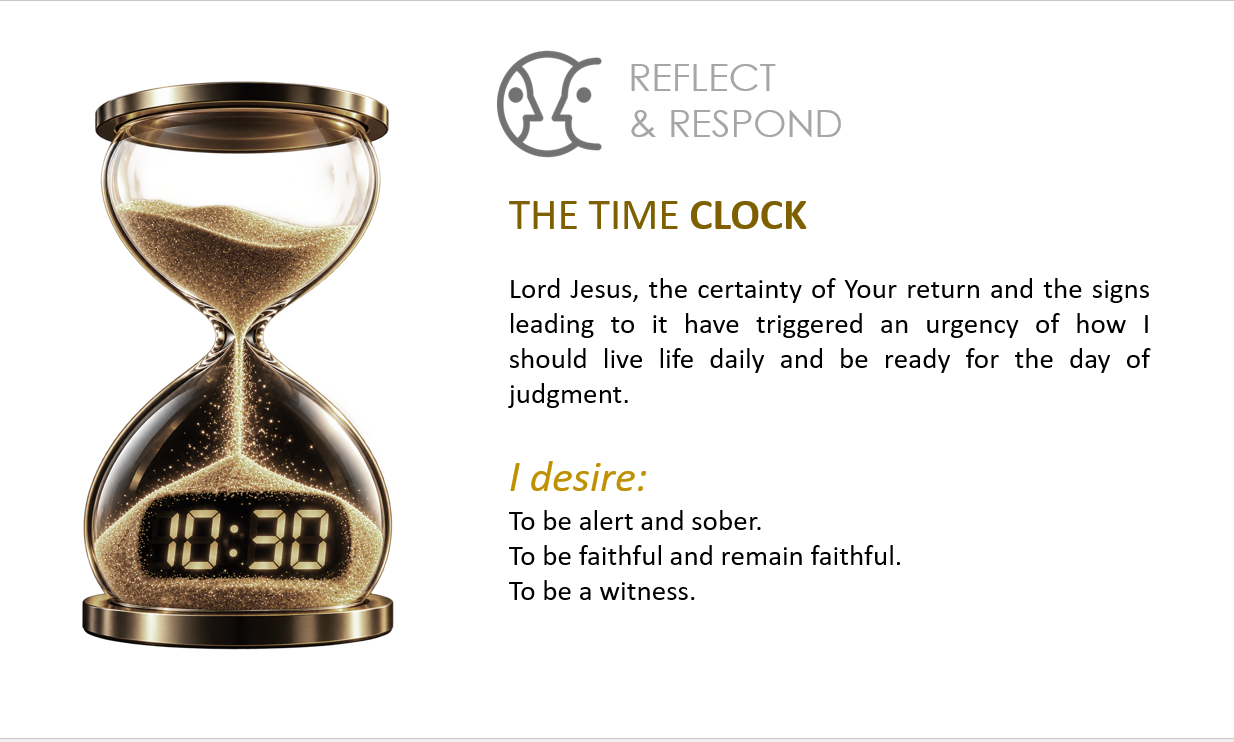
BE ALERT & SOBER
“The end of all things is near. Therefore be alert and of sober mind so that you may pray.” (1 Peter 4:7, 5:8). In ordinary lives, we are told to stay vigilant in detecting online scams, emerging threats to public health, the epidemic of loneliness, misinformation and in turning to AI agents for medical advice and companionship.
Similarly, believers are called to be watchful in detecting false teachings, temptations to rely on self rather than God in big and small matters, the embrace of relativism where biblical truths are replaced by ‘it depends’ arguments, and the slow drifting away of our faith in God. Therefore, it is biblical to look out for each other, and honestly point out hazards and risks that we allow to settle in our lives.
There is real concern in extending hyper-grace to ourselves and others, failing to address the stagnation of personal growth, and elevating belonging over transforming into Christlikeness where being together becomes more important than being alert and sober.
This is a sobering reminder of how unhealthy groupthink and status quo can creep into any faith community - even in the BeInReach community. Scripture clearly instructs us not to be lovers of self and lovers of pleasure. Which means, we are not to pursue an utilitarian lifestyle centred on what feels good and avoiding anything that causes pain or displeasure in our relationships like a loving rebuke from each other (2 Timothy 3:1-5).
If we are honest about it, unless we are the ones making or talking about them, we really don’t like making revisions, corrections or improvements. When was the last time you had a vulnerable conversation with another person so that you can work on changes together?
BE FAITHFUL
Being faithful to God is about our commitment to Him. It is not measured by how much time we clock in to serve God, or determined by the sacrifice of personal time or resources, even if we do all this with a joyful heart. Our relationship with God is always at risk of turning into an activity-based relationship without any depth when we prioritize tasks over intimacy.
It is very telling when most people are not getting better in relational skills and in making meaningful connections with each other, preferring to revert to the default position of privacy and independence as though they are biblical virtues.
Being faithful involves making time for what matters. With God, if we don’t habitually pause to invite His perspective into difficult situations, we will never catch the goodness that He reveals to us in what He sets us up for. With people, we can never know the meaning of an invite if we never show up to see what it means to the inviter. It is clearly not biblical to allow superficiality to replace intimacy in our relationships with family and friends. “Above all, love each other deeply, because love covers over a multitude of sins. Offer hospitality to one another without grumbling.” (1 Peter 4:8-9).
As sociologist, Esther Perez, opined, we conveniently treat contact with people as connection with them. When was the last time you invited someone to lunch or coffee for no other reason than to reconnect in the ordinariness of life? We can only become more resilient and reliable as a community when we walk in faithfulness to God together in the ordinary moments of life.
BE A WITNESS
Without ongoing and credible accounts of life with God, we are a poor witness for Christ. Surely, the Christian faith is not about gaining eventual access to Heaven and escaping from an eternity in Hell! If knowing Christ has not made any difference in our lives apart from our weekly time in church, and online with BeInReach Ministry, we are no more than mere subscribers to programmes!
Being a witness is about making ourselves accessible to others, and acquiring the social skills needed for meaningful interpersonal connections.
Paul committed his life to sharing with people about the kingdom of heaven. “For two whole years Paul stayed there in his own rented house and welcomed all who came to see him. He proclaimed the kingdom of God and taught about the Lord Jesus Christ – with all boldness and without hindrance!” (Acts 28:30-31). We can confidently say that Paul also regaled his audience with riveting personal stories about ordinary life as he experienced it – with disappointment, hurt, hardships and experiencing the intervening goodness of a loving God. It is not a stretch to say that Paul built a rich repository of relatable testimonies over his lifetime as God’s witness.
What is a recent personal story you can’t wait to share with someone today? Ask God to help you live with a sense of urgency and purpose. Practise vulnerability in sharing your faith stories. Deprioritize privacy over purpose and your life will look different one conversation at a time.
This is a summary and reflection based on a virtual BIR Session held on 31 October 2026.