IF NOT NOW, WHEN?
[8-minute read]
The saying that good opportunities only knock once justifies the thinking that we should always seize the moment and do something in our capacity to rise to each occasion. Speed, however, cannot override quality decisions, and it takes practice to develop good decision-making and take necessary risks.
People often say they don't know which open door to enter. When they stand at a fork in the road, they freeze in the face of choosing which path to take. Then, there are those who waste no time to make snap judgments and act on impulse hoping to land on good outcomes as though life is a roulette that spins at random. Still, there are others who will pause indefinitely to pray and languish in a state of passivity until the moment passes.
Perhaps we want to ask ourselves what are the important opportunities and moments we should not let go of without a suitable response.
Zacchaeus wasted no time to perch himself on top of a tree as soon as he heard that Jesus was approaching an eager crowd. He was looking for a personal connection with the Lord and was not going to let the disadvantage of shortness get in the way. Mordecai set in motion a risky undertaking that would involve no less than the royal household to save the Jews from being decimated. Blind Bartimaeus was sitting among a large crowd when he heard that Jesus was approaching and used the only instrument he could summon to get the Lord’s attention when he shouted, ‘“Jesus, Son of David, have mercy on me!”’ (Mark 10:46-52). Again, the woman with the a blood disorder emerged from self-quarantine to approach Jesus and received instant healing. Each of them read the room for opportunities of connection with Jesus and responded in different ways.
They were people who took their chances. They accepted the messiness of life. They were not too bothered if what they tried did not work out but they could not not take their chances.
John 5:1-13 describes a miracle that could easily have been lost and overlooked. Picture a pool surrounded by five covered colonades - impressive architectural elements - where “a great number of disabled people used to lie - the blind, the lame, the paralyzed”. What an unusal sight! For some reason, the pool is called Bethesda which means ‘house of mercy’. Many there had likely heard about things that happened here - the water got stirred, people with sickness and disability rushed into the water and were healed or felt better afterwards. Among them was a man who had been an invalid for 38 years. The Bible does not tell us if he was from out of town or if he was a local resident who spent his days around the pool. But he, like others, had great faith in what the waters could do to alleviate their suffering.
One day, Jesus entered this space, felt instantly drawn to him and went straight towards him. Wasting no time on preliminaries and platitudes, the Lord asked him, “’Do you want to get well’”’ (John 5:6).
His response was: “’I have no one to help me into the pool when the water is stirred. While I am trying to get in, someone else goes down ahead of me.’” A long time ago, this man had perhaps hoped to be well. But as he watched what people around him were doing about their circumstances, he began to think that getting into the pool would solve all his problems! ‘The man who was healed had no idea who (Jesus) was’ for the Lord made a quick exit before the religious leaders could confront Him. Yet, his conviction in what was widely accepted as good, culturally normative, and rooted in tradition was entirely overturned when Jesus told him, “‘Get up! Pick up your mat and walk.’ At once the man was cured; he picked up his mat and walked.” Instantly, he recognised the answer he needed from God.
In the backdrop, however, was a group of Jewish leaders – critics who were scrutinising every word and act of Jesus in order to call Him out for heresy and blasphemy.
In this story, there were clearly three actors: first, there was Jesus. Then, the man crippled by illness for 38 years. And lastly, the Jewish leaders who were vocal critics against the Lord. Anytime we assume that all believers, all women, all men, or all parents see things in the same way, it only exposes a naivete, a lack of life experience and critical thinking.
We’ll examine the heart, focus and response of the three key actors in this story.
THE HEART
The Lord’s heart constantly pulsates with mercy and compassion. There were specific reasons why He was drawn to one particular invalid in a place filled with so many disabled people. Imagine it was a hospital, who would Jesus heal? The Bible does not reveal the reason but we know that this particular invalid had never even once touched the pool water. The hopeful enthusiasm that brought him there had sunk to the bottom of human despair. When Jesus approached him, He reached out to the human behind the hopelessness. At the same time, what the Bible does not tell us is the kind of person the man was to the community there. Perhaps he was the one who spoke words of encouragement to the others around him while they waited for the waters to be stirred. Perhaps he provided comic relief to them, using humour to distract him from his own pain. Then, there were the critics – the Jewish leaders who rarely joined in any spontaneous celebration of personal victories in people. They were known for their fierce adherence to ceremonial observances and traditions and showed disdain for anything that happened outside these domains. To them, the Lord was an outsider and a law breaker who did not belong to the ‘institution’. He constantly broke the rules they had built by touching lepers, talking to women openly, eating with tax collectors, and now healing on a Sabbath. Their shift from defending their faith to protecting the institution was subtle; marinated in the language of faith.
THE FOCUS
We all have perspectives that either sharpen or diminish our ability to see opportunities to do something that matters for others. In our heads are voices that say someone else will step in, don’t intrude, don’t stir up conflict, or don’t rock the boat. Some of us are more desensitised to these self-limiting thinking than others because Jesus Himself models a life oriented - not towards self but - towards the hurting, the lost and the Cross. In this story, there is no doubt that the Lord was fully aware that it was a Sabbath day, but He also saw a man who needed to experience the power of God released into his life. And He wasn’t planning on returning to do it another day just to avoid controversy.
Meanwhile, the crippled man thought only about the timing and logistics of reaching the water in the pool when it was stirred. Very short-term, very near-sighted focus. From seeing the possibility of a full recovery and the return of normal life, his focus had tragically shrunk to the perimeters of the pool.
Also visibly present on this Sabbath were the Jewish leaders - not to support the lost and needy but to catch those who would violate their man-made Sabbath laws. And Jesus was their prime target. Naturally, when they saw the man they quickly recognised as one who had previously been unable to walk standing upright holding his mat, their first response was not joy but disdain: ‘It is the Sabbath; the law forbids you to carry your mat.’
It is easy to spot critics among us - no matter how faithful and godly they want us to believe they are - they rarely celebrate others’ breakthroughs, achievements and milestones that do not give them some form of credit or mention.
THE RESPONSE
The three actors mentioned had three different response in the story. While Jesus wasted no time to approach the invalid man to set him free from living on a mat, the man had by now grown attached to his disability, focusing only on what he could not do. Does this sound familiar to you?
To the Jewish leaders, however, nothing mattered except to catch Jesus breaking the Sabbath law. They were the ‘institution’ that labelled people as ‘with us’ or ‘against us’ according to their adherance to the laws they had constructed.
In the Lord’s defense, He told them, “’My Father is always at His work to this very day, and I too am working.’ For this reason they tried all the more to kill Him; not only was He breaking the Sabbath, but He was even calling God His own Father, making Himself equal with God.” (John 5:17-18).
This story unpacks and brings into tension God’s wholehearted mission to pursue the hopeless (even among us believers), humanity’s struggle to heal itself, and the hardened perpetrators of inhibitive norms and rules.
How are you inclined to act in any given situation? Our lives are enriched by personal experiences, not self-limiting opinions. When we can be present for others, when we can pray together (not in a closet), when we create a safe space for others without pressure for them to give only good reports to show that God is good. Like Jesus, we must be initiated when it comes to touching (each other’s) lives, and be attuned to humanity so we don’t misinterpret behaviour. Finally, we should “not withhold good from those to whom it is due, when it is in (y)our power to act.” (Proverbs 3:27).
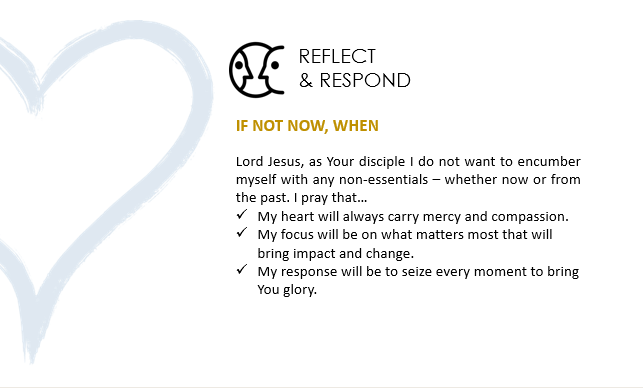
If not now, when?
This is a summary and reflection based on a virtual BIR Session held on 23 May 2026.