WHEN GOD SAYS…
[9-minute read]
What do you do when someone responds in a way you do not expect? You share a piece of good news like a promotion or an answered prayer and the person goes quiet, changes the subject, or offers a condescending "Good on you." You stand by someone through their worst season, sacrifice your own comfort and when things turn around for them, they distance themselves. You open up in a moment of vulnerability about a fear, a failure, or a private struggle and that admission in trust is used as a put down later on. Then, there are times that we surprise ourselves with responses we do not realise exist within us like over-agreeability, immaturity, and self-centredness that do not reflect who we really want to be.
How about times when God says things to us that we do not expect of Him? While God always responds to our prayers, His response can be no, or to wait, or to let go, or He could say nothing at all. Of course, it is also possible to mistake one answer for another.
Let’s take a closer look at some responses from God that is a departure from what we want or expect.
WHEN GOD SAYSNO
There is a common misconception that we can ask God for anything and it will be given to us because He is after all, God. We use answered prayers as a measurement of God’s power and goodness.If He is good and He is powerful, nothing should stop Him from giving us what we ask for. Relying onthe verse,‘Knock and the door will be open to you’ (Matthew 7:7), we knock on doors for anything we desire, and we ask God for ready-made solutions that require little or no involvement on our part.
But God doesn’t say yes just because we ask of Him. He had famously said no even to biblical legends.
To Moses, God made clear that he would not step foot on the Promised Land because he had broken faith with God and did not uphold His holiness among the Israelites (Deuteronomy 32:51-52). Still, Moses proceeded with what God instructed him to do before he passed away. He dutifully completed his assignment without ever seeing the Promised Land.
To David, God told him outright, “You are not to build a house for my Name, because you are a warrior and have shed blood." (1 Chronicles 28:3). God left no ambiguity about it. Later, David’s son Solomon built the temple.
To Paul who literally begged God to remove a ‘thorn in the flesh’ issue in his life, all God said to him was, “My grace is sufficient for you, for My power is made perfect in weakness.” It meant God would enable him to continue living with whatever was creating a great discomfort to him. (2 Corinthians 12:9).
What these ‘no’ answers revealed was not that God was fickle or temperamental but that He did not always give these faithful men everything they asked for. Yet, they remained faithful to Him even when He said no. Their love for God went beyond the answers they received from God. That was what made them legends of faith.
WHEN GOD SAYS WAIT
Waiting refers to the time between wanting something and receiving it like a dream vacation, someone to rent or buy a property, or a job offer. It is the state between a situation now and a desired state that we hope for like an apology, a reconciliation, or an improved medical report. It is the space between prayer and an answer from God.
Abraham waited 25 years for God to give him a child with his wife, Sarah (Genesis 15:2-4). During the time of waiting, he and Sarah took a misstep to intervene and produced an illegitimate son, Ishmael, as Abraham’s firstborn. They had thought that Ishmael was God’s blessing. “Then God said, 'Yes, but your wife Sarah will bear you a son, and you will call him Isaac. I will establish my covenant with him as an everlasting covenant for his descendants after him.” (Genesis 17:16-19).
Thomas waited a week before Jesus appeared in person; he had missed the Lord when He first appeared to the other disciples (John 20:25-26).
The disciples waited for the outpouring of the Holy Spirit after Jesus instructed them, 'Do not leave Jerusalem, but wait for the gift My Father promised, which you have heard Me speak about.’
Waiting is an important component in our relationship with God. Waiting itself does not suggest that something is wrong but it positions us in a place of self-discovery, conversation and deeper intimacy with God. We must pay attention to what we tell ourselves in times of waiting because it either develops relational maturity or stifles it.
“For the Lord God is a sun and shield; the Lord bestows favour and honour; no good thing does He withhold from those whose way of life is blameless.” (Psalm 84:11).
Do not ever doubt that God is at work in our lives. Sometimes He is working on things outside of us, but more often than not, He is forming a guiding perspective in us that can take a long time for us to catch because we are so focused on our external circumstances.
Don’t waste the time of waiting by numbing yourself with busyness and even noble projects. Ask God to reveal to you what you are not seeing in yourself and of the situation. The time between seasons of life and the space between chapters can feel like a threat to our wellbeing and safety. So, many of us prefer to act on ready-made conclusions in our minds instead of asking God to help us access our hidden fears. At the end of waiting for Abraham, Thomas and the disciples, there was a clarity about what they desired although it was experienced differently from what they thought.
Could it be that your waiting is stuck in your inability to see that God wants to do things differently this time?
WHEN GOD SAYS LET GO
Abraham had to let go of his country ties with extended family and community when God told him, “'Go from your country, your people and your father's household to the land I will show you.’” (Genesis 12:1).
Ruth was prepared to let go of her attachment to her family of origin when she told Naomi, “’Where you go I will go, and where you stay I will stay. Your people will be my people and your God my God.’” (Ruth 1:16b-17).
Esther had to let go of compliance with palace protocols to take the high risk of seeing the king without being invited (Esther 4:16b).
There are times when we let our loyal attachment to groups, alliances, and institutional traditions override and limit our ability to respond to God. When letting go and following God’s leading feels unsettling and ambivalent, because it carries deep emotional weight we are uncomfortable with.
God did not call Abraham to reinvent himself while staying put in his motherland. Ruth could not follow Naomi without uprooting from where she was. Esther would not be taking risks without stepping out of the safety of her chambers and stepping into the king’s court.
“Forget the former things; do not dwell on the past. See, I am doing a new thing! Now it springs up; do you not perceive it? I am making a way in the wilderness and streams in the wasteland.” (Isaiah 43:18-19).
What are you afraid of letting go?
WHEN GOD SAYS NOTHING
Think of the times when it seemed as though God fell silent on you. How did it feel? Is it happening again now? If we are honestly connected/in touch with to our emotions, we would admit to feeling confused, alone, anxious and even angry. Emotions are not sins: they tell us that something is important to us and we need God. Left alone, we often interpret His silence for His absence, which is far from the truth. Yet, His silence is rarely comforting when we need Him to say something.
Yet, there are times when God chooses to remain silent …. for a while. (And no, it doesn’t always mean He is tone-deaf).
David expressed despair when God said nothing: To you, Lord, I call; You are my Rock, do not turn a deaf ear to me. For if You remain silent, I shall be like those who go down to the pit. (Psalm 28:1).
Asaph felt lost and alone: O God, do not remain silent; do not turn a deaf ear, do not stand aloof, O God. (Psalm 83:1).
Job felt unheard and alienated: I cry out to you, God, but You do not answer; I stand up, but you merely look at me. (Job 30:20).
When God is not speaking, He is still observing, listening, and near. Silence from God is not an indication that He is unhappy in His relationship with us. In fact, it is okay to say that God has not said anything ….yet.
TRUST GOD
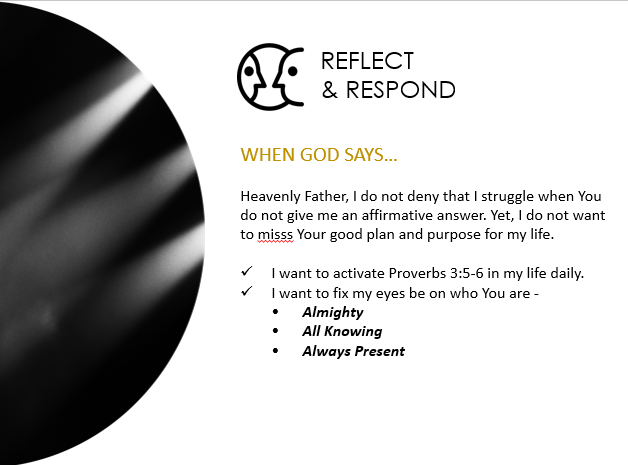
When God does not respond in the way we expect, our response to Him matters more than our knowledge of Him. We need to trust His character.
Trust in the Lord with all your heart and lean not on your own understanding; in all your ways submit to Him, and He will make your paths straight. (Proverbs 3:5-6).
Trust God who is almighty. A miracle is too easy for Him. Ah, Sovereign Lord, You have made the heavens and the earth by Your great power and outstretched arm. Nothing is too hard for You. (Jeremiah 32:17).
Trust God who is all-knowing. Nothing escapes Him. Oh, how great are God's riches and wisdom and knowledge! How impossible it is for us to understand His decisions and His ways! (Romans 11:33).
Trust God who is always present. There is no domain He cannot enter. He is there under your duvet with you. He is there when you are feeling crushed and refuse to respond to Him. He is there when you are hiding in the toilet struggling and feeling overwhelmed. (Psalm 139:7-12).
This is a summary and reflection based on a virtual BIR Session held on 17 May 2026.