[8-minute read]
ONE QUESTION HAS STOOD THE TEST OF TIMES since biblical days: “And who is my neighbor?” The ‘expert in the law’ who first posed this timeless question to Jesus in Luke 10:25-29 lived in a bubble of self-importance and self-absorption that is not very different from our lives today. The question is not meant to disarm Christians, but increasingly, it deserves greater attention. Many people today are caught in an existential crisis where we have no energy and no time for anything beyond getting through each day.
The problem is systemic. Christians, like everyone, are increasingly relying on technology to replace in-person connections out of sheer convenience. Hearing each other’s voice, spontaneous touches, catching body signals and facial expressions are dramatically missing in our live interactions. Our interactions are so dehumanized that people feel normal about turning to AI companions because they are more accessible than the people in their lives.
While technology may make us feel more connected - just because we can send or respond to a text message anytime of the day or night - it doesn’t mean that we are more available to each other. A series of quick updates in a group chat does not help someone who’s quietly spiraling into despair. And just because we see what’s going on in someone’s life on their social media posts doesn’t mean we are there with them when life hits hard even when their posts show a smiling face. This is not a contradiction but a cultural conditioning we cannot escape unless we become aware of it.
Therefore, “And who is my neighbor?” becomes important in reversing the gradual erosion of biblical neighbourliness. This is a matter close to God’s heart since the beginning of humanity. God said to Moses, “I have indeed seen the misery of my people in Egypt. I have heard them crying out because of their slave drivers, and I am concerned about their suffering.” (Exodus 3:7).
When was the last time you saw, heard and were concerned about someone in the ordinariness of your life that you were moved to do something about it?
To be sure, Jesus lived in first-century pre-industrialised times without time-saving automation and technology. People walked on foot or travelled on donkeys, and worked primarily with their hands – all pretty time-consuming and labour-intensive. People could not be more time-strapped! Yet, His followers were told to love their neighbours. To emphasize that His mandate was meant for everyone, the Lord shared a parable about three everyday characters – a priest, a Levite and a Samaritan man - and their reactions when they saw a man left for dead after being robbed.
The incident would happen on a familiar route linking Jerusalem which sits about 750 metres above sea level to Jericho that lies well below sea level. A rough terrain that was uninhibited, and robbery was a constant danger. The victim could possibly have carried visible artefacts of value to robbers when he was attacked because they didn’t just rob him but ‘They stripped him of his clothes’.
Yet, both the priest and the Levite, who were religious figures held to high moral standards, saw the man and “passed by on the other side”. People who should have known better turned a blind eye and did not extend basic compassion to the helpless victim. On the other hand, the Samaritan man - a non-Jew, a much despised outsider, an ordinary civilian - “when he saw him, he took pity on him… The next day he took out two denarii and gave them to the innkeeper. “Look after him,” he said, “and when I return…”
As believers, we have no excuse ignoring the people existing in our social orbit, and showing an interest in knowing what is going on in their lives. God doesn’t tell us only to show kindness to the down and out, to those who are disadvantaged in life, or to communities who rely on charity. He tells us to look out for each other (ie, other believers) and to the people in our community at large.
Without any ambiguity Jesus instructed, “For there will never cease to be poor in the land. Therefore, I command you, “You shall open wide your hand to your brother, to the needy and to the poor, in your land.” (Deuteronomy 15:11 ESV).
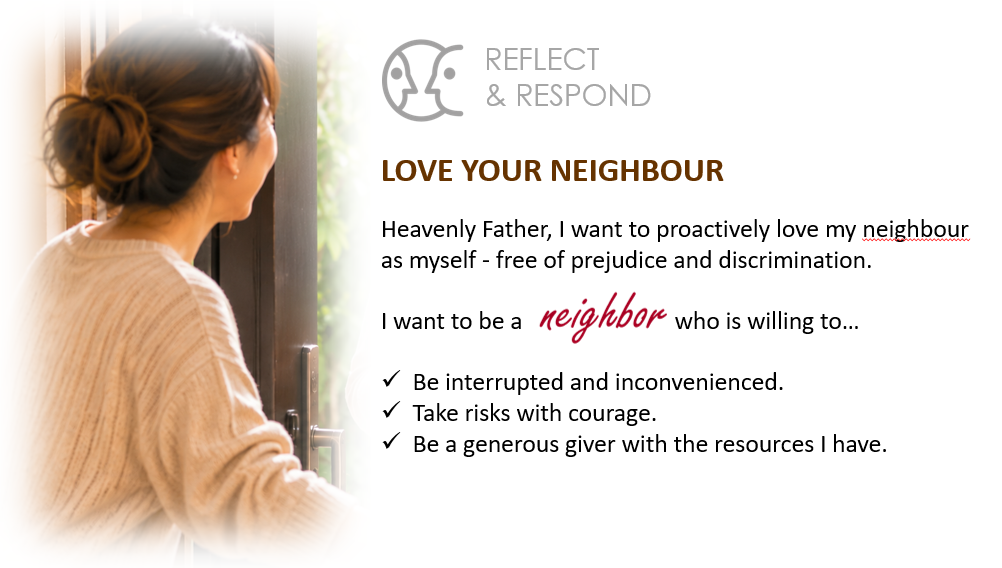
Here are three considerations for how to love our neighbour and be a neighbour.
1.BE WILLING TO BE INTERRUPTED & INCONVENIENCED
Truth be told, we prefer to politely wait to be informed rather than initiate to show we are interested in someone’s life. Despite having the technology that enables us to be more connected than ever, we could not be more disinterested in each other’s affairs. When we allow privacy and independence to become sacred virtues, they erode the intimacy and inter-dependence that make us caring neighbours to each other.
The Samaritan man in Jesus’ parable acted with spontaneity and demonstrated a personal interest to restore safety and well-being to a fellow human being. Instantly, he became a neighbour when he made space for another person. To be a neighbour requires showing interest, intent, initiating contact, and investing in someone's well-being. When we wait and let time pass by, we are acting in the same way as the priest and the Levite who “passed by on the other side”! They were preoccupied and cared nothing for disruptions. Surely, everyone on that route from Jerusalem to Jericho had somewhere to go to, and something to do. But the Samaritan, who had nothing to gain in helping an anonymous person in a remote place, allowed his schedule and plans to be interrupted and adjusted to help a fellow human that crossed his path.
Mother Theresa - a petite woman herself – was known to pick up humans left to die in gutters and waste bins. She would pick them up herself and bring them home to die in dignity. These days, we conveniently meet up with each other in third places like restaurants and cafes instead of opening our homes for casual chit-chats and time together. Our private and public lives never converge: when we step out to meet friends, they see only our public persona – carefully curated and intentionally superficial.
While we may not deliberately act in hurtful ways (God forbid!), we fail to practise godly neighbourliness towards each other when we never initiate contact, rarely check in, take each other for granted, and skip the important moments in each other’s lives.

2.BE WILLING TO TAKE RISKS
There were many risks involved in helping a total stranger. For the priest and Levite, they risked being defiled for religious duties. But the Samaritan man was willing to take whatever risks – including his own safety - to save someone lying helpless by the roadside. Certain risks are worth taking to uplift humanity and deepen interpersonal connections. Self-preservation, on the other hand, keeps things consistently distant and shallow.
How willing are we to take the necessary risks to initiate closeness to help someone. The risks are plenty: they include the risk of feeling uncomfortable, inadequate and intrusive. For those who see everything as a performance, there is the risk of being rejected by the person we extend kindness and friendliness to.
There is, of course, the perennial risk of assessing goodness by immediate feedback. We expect every effort to pay off immediately, or it is not worth doing. If someone does not accept our invite, they are rejecting the friendship. If someone does not use the information or tool we offer to improve their quality of life, our effort is wasted.
Often, friendships don't break dramatically; they fade through neglect and the lack of nurture. In some circles, there is an unhealthy norm of publicising our acts of spontaneous care within church groups as an act of accountability to each other. Let’s be real: no one wants to become the object of our show and tell each time we deliver an act of kindness that simply connects us as humans.
3. WILLING TO BE A GENEROUS GIVER
The Samaritan man acted generously when “… he put the man on his own donkey, brought him to an inn and took care of him.” He even returned the next day with a significant amount of money to pay for his expenses. In other words, he put his skin in the game.
Being generous is about making space in our lives to accommodate people in our circle of influence. Sending a kind word, making a call, extending an invite to catch up are not things we do because we have excess time but because these are things people do to love their neighbours.
We can act with generosity without comparing ourselves with others. Expensive gifts may be culturally acceptable but consistent spontaneous gestures mean more than a show of extravagance. The point is not to draw attention to anyone but to deepen the connection.
Romans 13:8-10 warns us, “Let no debt remain outstanding, except the continuing debt to love one another, for whoever loves others has fulfilled the law. 9 The commandments, ‘You shall not commit adultery,’ ‘You shall not murder,’ ‘You shall not steal,’ ‘You shall not covet, and whatever other command there may be, are summed up in this one command: ‘Love your neighbour as yourself.’10 Love does no harm to a neighbour. Therefore, love is the fulfilment of the law.”
This is a summary and reflection based on a virtual BIR Session held on 21 November 2026.